
I have sat inside enough organizations to know that a governance document, no matter how thorough, does not change behavior at the task level. What changes behavior is something simple enough to recall in the middle of a workday, without having to open a file or ask a manager.
According to the PEX Report 2025, only 43 percent of organizations have an AI governance policy in place and nearly a third have none at all. But even among those that do, the AuditBoard research study From Blueprint to Reality found that only one in four organizations have governance that is fully operational. The rest have documentation. Not adoption. That distinction matters more than most leadership teams realize.
Where Most AI Governance Falls Apart
Governance frameworks are being built at the top and handed down. What is rarely built is the middle layer, the practical guidance that helps an employee decide, in real time, whether the task in front of them is appropriate for AI or not.
Most firms have drafted policies but struggle to turn them into daily practice. The barriers are not technical. They are human, unclear ownership, limited context, and guidance that was never designed to travel from the boardroom to the individual contributor’s workflow.
IBM’s 2025 Cost of a Data Breach Report found that 63 percent of organizations that experienced a data breach had no formal AI governance policy in place. That is a significant risk. But the deeper risk is the organizations that have a policy and still lack the daily infrastructure to enforce it because a document that employees cannot recall under pressure offers very little protection.
Governance at the Task Level
Governance that works does not start with a policy. It starts with a question every employee can answer without hesitation: Is this task appropriate for AI?
That question needs a framework simple enough to use without training, visual enough to remember without reviewing, and specific enough to drive consistent behavior across every role in the organization. That is what I have been testing inside organizations, a framework built around something everyone already understands before you finish explaining it.
Watch: The Steering AI Framework Explained
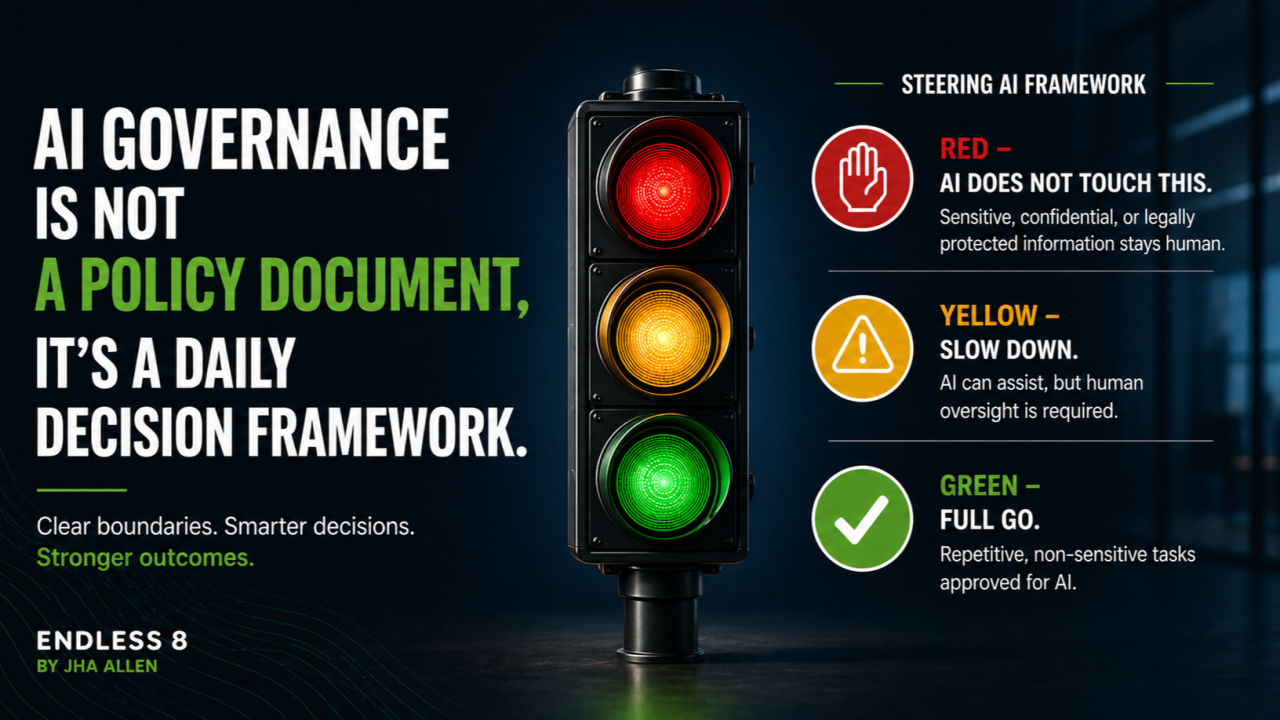
I call it the Steering AI Framework. It works exactly the way traffic lights do.
Green - Full Go
Yellow - Slow Down
Red - AI Does Not Touch This
Simple Frameworks Outperform Complex Policies
The reason the Steering AI Framework works is because it does not require employees to remember language. It requires them to make a call, the same kind of call every driver makes at an intersection without thinking twice.
What I have seen consistently across organizations is that simple, visual frameworks close the gap between the training session and the moment of decision. They give employees permission to use AI confidently where it is safe, a clear checkpoint where caution is needed, and a firm line where the organization’s risk begins.
Governance does not restrict AI adoption. When it is designed well, it directs it.
Making the Framework Part of How Your Team Works
Governance does not have to be complicated to be effective. It has to be usable. Start by auditing your team’s most frequent tasks and sorting them into green, yellow, and red. Share the framework visually not just in onboarding but embedded where work actually happens.
The organizations that lead in responsible AI adoption will not have the longest policy documents. They will have teams that can answer without hesitation whether the task in front of them is a green, a yellow, or a red.

The 30-Day AI Workflow Implementation Plan
Start with The 30-Day AI Workflow Implementation Plan to begin mapping AI to the workflows that matter most. For teams ready to move from framework to implementation, the AI Briefing and Customized Applied AI Workshop are built around your organization’s specific workflows and team structure designed for both technical and non-technical professionals.
Email partner@endless8training.com to get started and follow Endless 8 on LinkedIn for continued frameworks on AI Integration and workforce readiness.