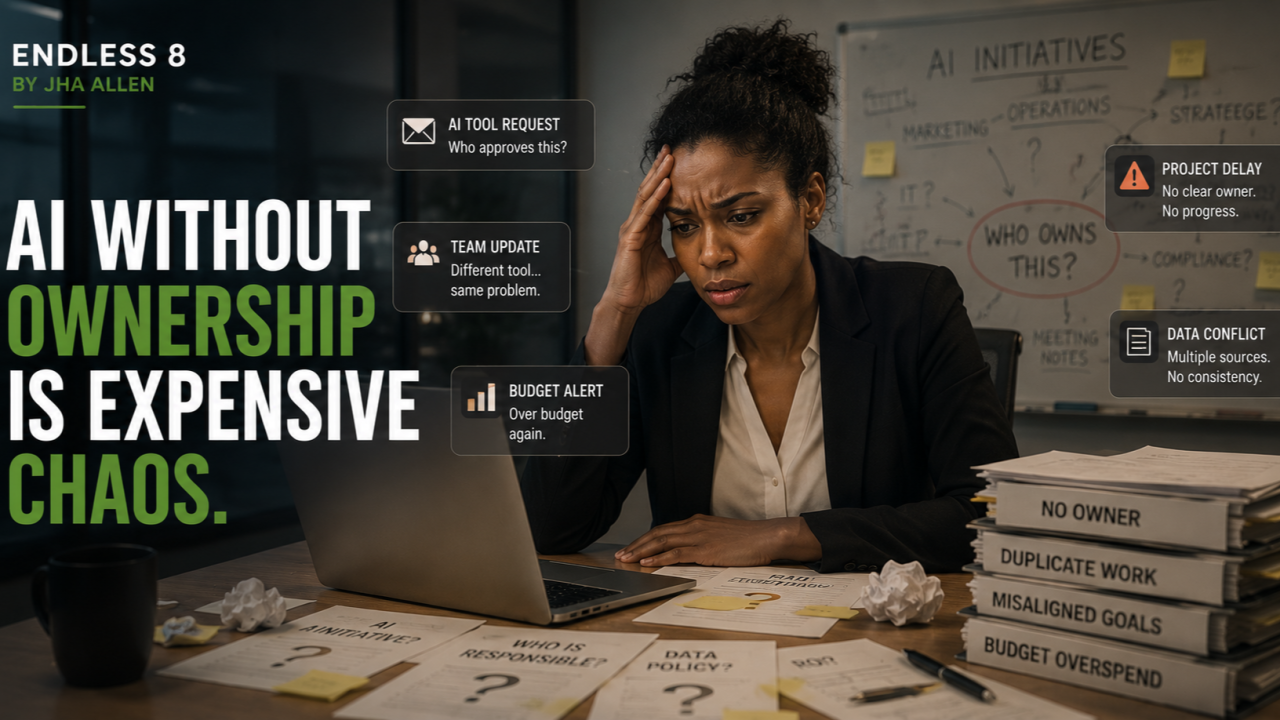
Organizations are not slowing down their AI investment. Budgets are growing, tools are being added, and training programs are expanding. Yet inside most of those same organizations, employees still cannot tell you who is responsible for making AI work on their team. The problem was never the budget. It was always the ownership.
Most AI initiatives stall not because of insufficient funding but because of insufficient accountability. There is no defined person or team responsible for how AI gets used, measured, or improved inside each function. Leadership assumes it is being handled. Employees assume someone above them has the answer. Meanwhile, nothing moves regardless of how much has been spent on tools or training.
According to ISACA’s 2025 white paper on AI governance, the most critical gap inside organizations is the lack of clear ownership of AI governance. Without it, key stakeholders, IT leaders, compliance officers, and business executives fail to align AI systems with the organization’s policies and overall strategy. The result is fragmented oversight and an organization that cannot fully understand the broader impact of AI on its operations.
When Everyone Is Responsible, No One Is
Ask ten people inside the same organization who is responsible for AI on their team. Most will give you a different answer. Some will say IT. Some will say L&D. Some will say leadership. A few will say they genuinely have no idea. When AI is treated as a shared responsibility across the organization, it effectively becomes nobody’s responsibility. There is no one to define how AI should be used inside a specific role. No one to answer questions when employees are unsure. No one to step in when adoption stalls or when AI is being used in ways it should not be. MIT Sloan Management Review found that organizations struggle to implement responsible AI processes not because of a lack of intent but because of structural and cultural obstacles, specifically a lack of clear ownership at the project and functional level. Their research identifies structuring ownership at the project level as the first step to getting AI efforts back on track. Spending more does not solve an accountability gap. It just makes the gap more expensiveThe Role Most Organizations Have Not Defined Yet
Clear AI ownership is not about creating a new job title or adding another layer of management. It is about defining accountability at the level where work actually happens. Someone needs to be responsible for AI integration inside each function not just at the organizational level but inside the day-to-day work of specific teams. There needs to be a clear path for employees who have questions about appropriate AI use. Someone needs to monitor whether AI is actually being used, whether it is producing the right outcomes, and whether the team needs additional support. PwC’s 2025 Responsible AI Survey found that organizations with clear ownership enable faster and more coordinated decision-making between technical and risk teams. Organizations at the strategic stage of AI governance are 1.5 to 2 times more likely to describe their responsible AI programs as effective compared to those still in the early stages. Accountability, distributed clearly across builders, reviewers, and assurers, is what makes that difference. Ownership creates the conditions for everything else to work. Without it, training, tools, and strategy have no stable ground to stand on.The Cost of Leaving It Undefined
The impact of unclear ownership shows up at every level of the organization but the people who feel it most are the ones in the middle. Managers who are expected to lead AI adoption on their teams but have never been given clear authority or guidance to do so. Employees who completed the training but have nowhere to turn when they hit a wall. Teams where AI use is inconsistent because every person is making their own judgment call about where it fits. Leadership wondering why adoption is slow when the tools are in place and the training has been done. The investment is rarely the issue. The absence of a clear owner, someone who bridges the gap between organizational strategy and daily execution is.What Clear Ownership Changes
When ownership is defined, the experience inside the organization shifts. Employees know who to go to. Managers have the authority and context to lead adoption on their teams. Questions get answered. Progress gets measured because someone is accountable for the outcome. Getting there does not require a larger budget. It requires a deliberate decision about who owns AI inside each function and the organizational support to back that decision up.